Zygomatic dental implants in Mexico
No Bone? No Problem.
$4,500 per unit. Anchored to the cheekbone (40–55mm) — no bone graft, no sinus lift. Dr. Omar Lugo has been placing zygomatic implants in Mexico since 2019. Free complex case review.
- 4.9/5 from 1,247 reviews
- 8,000+ Americans & Canadians treated
4.9 1,247 reviews
What Are Zygomatic Dental Implants?
Zygomatic implants are longer implants (40–55 mm) that anchor into the cheekbone — the zygoma — instead of the upper jaw. That bone stays dense and strong even when the maxilla has been lost to years of atrophy, so patients with severe bone loss can get fixed teeth without a bone graft or sinus lift. Dr. Omar Lugo was the pioneer of this technique in Mexico in 2019.
When Are Zygomatic Implants the Answer?
The 'no bone? no problem' cases.
Severe atrophy
Almost no upper-jaw bone left
When the maxilla has resorbed, standard implants have nothing to grip. The cheekbone provides the dense anchorage.
Failed treatment
Failed grafts or sinus lifts
If a bone graft or sinus lift didn't take, zygomatic implants bypass the problem bone entirely.
Denture wearers
Years in a denture
Long-term denture use accelerates upper-jaw resorption. Zygomatic implants give you fixed teeth without rebuilding bone.
Zygomatic Implants vs. Sinus Lift + Bone Graft
Zygomatic implants
- Anchors into cheekbone (40–55mm) — bone that never resorbs
- No bone graft, no sinus lift, no donor site
- One surgery instead of two or three
- Temporary fixed teeth the same day
- $4,500 per unit, itemised in your written quote
Sinus lift + bone graft
- Months of healing before implants can even be placed
- Grafts can fail, resorb or become infected
- Multiple surgeries, extra costs and longer downtime
- Not possible at all in extreme maxillary atrophy
| Service | Price |
|---|---|
| Zygomatic implant (per unit) | $4,500 |
| COMPLETE ZIRCONIA — 2 trips (First $12,800 + Second $7,000) | $19,800 |
| SINGLE ARCH | $9,000 |
| ONE-TRIP FULL MOUTH | $14,990 |
| Hotel Fiesta Inn Cumbres — 6 nights, 2 guests | Included |
Packages don't expire. No lock-in.
Meet Mexico's Zygomatic Pioneer
Dr. Omar Lugo
D.D.S., M.S. — Maxillofacial Surgeon, Certified in Zygomatic Implants
Dr. Omar Lugo pioneered zygomatic implants in Mexico in 2019 and remains one of the few surgeons certified in the technique. With 25+ years restoring full arches, he is a member of IAOMS, ICOI, the Mexican Board of Oral & Maxillofacial Surgery and AOCMF.
- Zygomatic implants
- Severe maxillary atrophy
- All-on-4 implants
- Guided implant surgery
2019
pioneered in Mexico
From the first zygomatic case to today, every plan starts with a CBCT scan and a written quote — no generic protocols, no surprise costs. 8,000+ American and Canadian patients treated.
Request Your Free Complex Case Review
Share your X-rays or CT scan. Response within 24 hours with a written treatment plan — no commitment.
Zygomatic Implants — FAQ
Does getting zygomatic implants hurt?
No more than any implant surgery. You're under IV sedation during placement, and post-operative pain is managed with medication.
Am I a candidate for zygomatic implants?
Zygomatic implants are for severe upper-jaw bone loss: advanced maxillary atrophy, failed grafts or sinus lifts, and long-term denture wearers. The free complex case review confirms candidacy.
Do I still need a bone graft?
No — that's exactly what makes zygomatic implants different. They anchor in the cheekbone, so the missing upper-jaw bone is simply bypassed. No graft, no sinus lift, no months of waiting.
Where a zygomatic implant actually goes
It bypasses the jaw entirely. That is the whole idea.
Into the cheekbone, not the jaw
A conventional implant needs upper jaw bone that severe resorption has already taken away. A zygomatic implant is longer — 40 to 55 mm against the usual 10 to 13 — and travels up past the sinus to anchor in the zygomatic bone, the cheekbone, which does not resorb when teeth are lost because it never held teeth in the first place.
Why that removes the grafting wait
The alternative for a severely resorbed upper jaw is building bone that is not there: sinus lift, graft, and six to nine months of healing before implants can even be placed. Zygomatic implants anchor in bone that already exists, so the arch can be loaded on the same timeline as any other full arch.
What you see is the same bridge
The zygomatic part of the plan is entirely under the gum. What you chew with is the same screw-retained temporary the day of surgery, and later the same monolithic Prettau zirconia milled in our own lab. Nothing about the finished arch looks or works differently because of what anchors it.
Why not everyone gets them
They are a solution to a specific problem, not an upgrade. If you have enough bone, a standard implant is simpler, faster and cheaper. Zygomatic placement is a demanding procedure near the sinus and the orbit, and it belongs in the hands of a maxillofacial surgeon — which is exactly why most clinics refer these cases out.
Who ends up needing them
Four routes to the same place: an upper jaw with nothing left to anchor into.
Long-term denture wearers
An upper denture presses on the ridge every day. Ten or fifteen years of that resorbs the bone underneath, which is why a denture that fitted once no longer holds.
Failed previous implants
Implants that failed and were removed leave less bone than there was before. A second attempt in the same site often has nowhere to go.
Failed or refused grafts
Grafts do not always take, particularly in smokers. A patient who has already spent nine months and a graft that did not integrate is the classic zygomatic candidate.
Told no elsewhere
The most common first sentence we hear is that another clinic said there was not enough bone. That is usually accurate and usually not the end of it.
What the procedure involves
Longer surgery, same recovery pattern, different anatomy.
On the day
- IV sedation: you are asleep for the whole procedure
- Navident guided placement, planned on your CBCT beforehand
- Two to three hours rather than the usual one to two
- Fixed temporary teeth on the same protocol as any full arch
Afterwards
- More facial swelling than a standard case, because the path is longer
- Sinus precautions for a few weeks: no nose blowing, no straws
- Same four-month healing before the final zirconia
- $4,500 per zygomatic unit, quoted from the scan before you travel
Dr. Lugo has placed zygomatic implants since 2019, when he became one of the first certified surgeons for the procedure in Mexico.
What the scan has to show before any of this is possible
Zygomatic candidacy is a measurement, not an opinion. It comes off the CBCT.
The cheekbone itself
The zygoma is not the same size or the same shape in everybody. The scan measures how much bone the implant will actually engage along its path and at what angle it has to enter to reach it. That measurement, not the state of your upper jaw, is what makes the plan possible.
The maxillary sinus
The implant runs alongside or through the sinus on its way up. The scan shows the shape of the sinus floor, the thickness of its lining and whether there is inflammation already there. All three change the approach, and the third can postpone surgery until it has been treated at home.
What survives at the front
Between the canines the bone often outlasts the back of the jaw by years. If the scan shows enough of it, two conventional implants at the front do half the work and only the posterior needs zygomatic anchorage. If it does not, the plan changes shape entirely — and so does the quote.
Why a panoramic X-ray will not settle it
A panoramic is a flattened image. It cannot show bone thickness front to back, and thickness is the entire question here. Send a CBCT if you have one. If all you have is a panoramic, we will tell you what it does and does not answer rather than quote you on a guess.
When zygomatic implants are the wrong answer
They solve one specific problem. Outside it, they are the harder route to a worse result.
There is no lower-jaw version
Zygomatic implants exist because the cheekbone sits above the upper jaw. Nothing equivalent sits under the lower one. A severely resorbed lower arch is handled with angled implants, shorter implants or grafting — never with a zygomatic. If your bone loss is at the bottom, this is not the procedure you are looking for.
A graft would still work
Some resorbed jaws can still be grafted successfully, and if the scan says yours is one of them you have a genuine choice: several months of healing and then conventional implants, or zygomatic anchorage now. That is a trade between time and surgical complexity, and you should hear both sides of it before deciding.
An untreated sinus
Chronic sinusitis, polyps or an active infection are reasons to wait, not to press on. The implant shares space with that sinus for the rest of its working life, so it goes in when the sinus is quiet. Sometimes that means seeing an ENT at home before you book a flight.
Healing that cannot be relied on
We ask about smoking, uncontrolled diabetes, head and neck radiation and bone medication before we quote. None of them is an automatic no, but each one changes the risk of a long implant in a demanding site. A surgeon who does not ask those questions is not planning your case.
Two or four — how many your case needs
The count comes off the scan, and it is what moves the number on your quote.
The hybrid: two at the back
The common configuration. Two zygomatic implants carry the posterior where the bone is gone, and two conventional implants sit at the front where it survived. One arch, four anchors, one bridge.
Quad zygoma: four
When resorption has taken the front of the maxilla as well, there is nowhere left for a conventional implant. Two zygomatic implants per side then carry the whole arch. It is the most demanding version of the procedure.
What each unit adds
A zygomatic implant is priced per unit at $4,500, and the arch it supports is $9,000 for one or $14,990 for both on the One Trip plan. Two units and four units are very different quotes, which is why the number is settled from the scan before you travel.
The count is not a preference
Patients sometimes ask for the smaller configuration. The number is set by where there is bone to hold an implant. We will show you on your own scan why the plan says what it says.
What can go wrong, and what it asks of you afterwards
A long implant that passes the sinus behaves differently from a short one in the jaw. Here is the uncomfortable half.
Sinus inflammation
Sinus inflammation is the complication that matters most here, and it can appear months or years after surgery rather than in the first week. It usually shows up as congestion or discharge on one side only. It is treatable, and it is the reason to report a new one-sided symptom instead of waiting it out.
The gum at the implant head
A zygomatic implant emerges higher and further towards the palate than a conventional one. The soft tissue around that emergence can recede over time. That is a hygiene and comfort issue rather than a structural one, and it is managed with cleaning technique and occasionally a small soft tissue procedure.
If one fails
A failed zygomatic implant is a larger event than a failed conventional one. Removing it is surgery, and whether it can be replaced depends on what the site has left. That is the honest argument for having the procedure done by a maxillofacial surgeon rather than by whoever quoted lowest.
What you do from here on
- A soft diet through the four months on the temporary bridge, before the final zirconia
- A water flosser under the bridge every day — brushing alone does not reach it
- A hygiene visit every six months with a dentist at home, and a periodic deep clean with the bridge unscrewed
- Keep the record of which implants were placed. You will want it if anything is ever done at home
Why patients choose us for zygomatic dental implants
Lower overhead, not lower standards. The difference is where the money goes, not what goes in your mouth.
A surgeon operates, not a general dentist
Dr. Omar Lugo is a board-certified Oral & Maxillofacial Surgeon (D.D.S., M.S.) with 25+ years and 8,000+ American and Canadian patients. He plans your case on the CBCT, performs the surgery himself and signs off the prosthetics. Nothing is delegated.
The same implants as the USA
FDA-approved Nobel Biocare, Straumann and BioHorizons — the systems placed in American offices every day, with a lifetime warranty on the implant. No unbranded posts, no systems you cannot get serviced back home.
Our own zirconia lab, on site
Monolithic Prettau milled from a single block on five axes, with 2 to 3 try-ins. No outsourcing, no courier delays, no middleman markup — and a technician who can walk into the surgery and look at your bite in person.
A written price, locked
Your quote arrives in USD before you book a flight, itemised, with what you need and what you do not. It is locked for 12 months. No verbal estimate that changes when you are in the chair with your teeth already out.
Why Cancun for zygomatic dental implants
Not just the price. The flight, the hotel, the recovery and the protocol.
2 to 4 hours, non-stop
Direct flights from Miami (~2h), Houston (~2.5h) and Dallas (~3h). You leave in the morning and you are at the clinic the same day — closer than driving across some US states for the same treatment.
Hotel and transfers included
Six nights at Fiesta Inn Cumbres for two guests, plus airport pickup and daily transport to the clinic. Your companion travels at no extra cost, and the clinic is a short walk away.
You recover on a beach
Post-surgical rest happens somewhere warm with good food and no work email, instead of at home juggling the school run. Patients consistently report it is the part they underestimated.
An implant-only centre
Not a general clinic that also does implants. IV sedation, Navident guided surgery, hospital-grade sterilisation and the Malo Clinic protocol — the same standards, in a city built for international patients.
Zygomatic Dental Implants Reviews in Mexico
Surgery Tuesday, fixed teeth by Friday. Hotel and transfers included, exactly as written in my quote.
Texas — One Trip $14,990
My dentist in San Diego quoted $25,000. I paid $9,000 and the work is flawless. Dr. Lugo reviewed my CBCT personally.
California — One Arch $9,000
Two trips, one written price, permanent zirconia. Saved over $35,000 vs my US quote. The coordinator handled everything.
Florida — All-Inclusive $19,800
Second trip for final zirconia — never stains, feels natural. 5 days, hotel included again. Worth every mile.
Arizona — Zirconia Upgrade $7,000
Swipe to see more →
Patients tell it better
No script. Recorded at the clinic.

"Surgery Tuesday, fixed teeth by Friday. Saved over $35,000 vs my Dallas quote."
Texas — Full Mouth

"My dentist quoted $25k. I paid $9,000 in Cancun and the work speaks for itself."
California — One Arch

"Flew home with fixed teeth in under a week. The in-house lab made it fast."
Florida — One Trip
Swipe to see more →
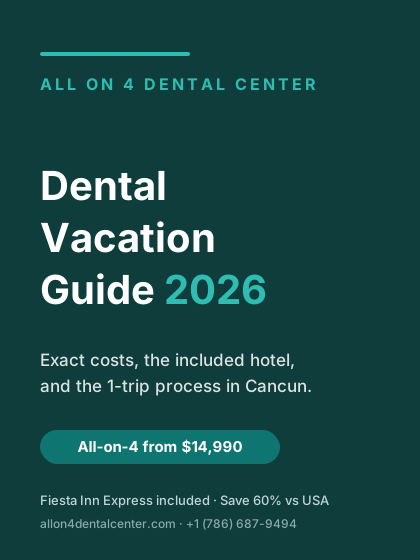
Free download
The Dental Vacation Guide 2026
Exact costs, the included hotel, and the 1-trip vs 2-trip process — the same guide we hand every patient at consultation. No registration to read it.
5 pages · PDF · 10 min read
- Exact All-on-4 Cancun costs: $19,800 full mouth, $14,990 One Trip
- Zirconia upgrade $7,000 both arches — never stains, most natural
- What's always included: hotel, IV sedation, CBCT scan, airport pickup
Request Your Complex Case Review
Send your CT scan or X-rays. Dr. Lugo's team will tell you whether zygomatic implants are right for your case — free, with a written plan and a fixed price in USD.
We reply within 24h · No commitment